An API Ring Type Joint (RTJ) flange is a specialized, high-integrity connection designed for one primary purpose: to contain extreme pressure without leaking. Common in oil and gas, petrochemical, and other severe service industries, it uses a uniquely engineered metal-to-metal seal.
This guide explains how RTJ flanges work, the different ring types, and why they are chosen for the world’s most demanding piping applications.
How an RTJ Flange Seal Works
The sealing principle of an RTJ flange is different from a standard Raised Face (RF) flange.
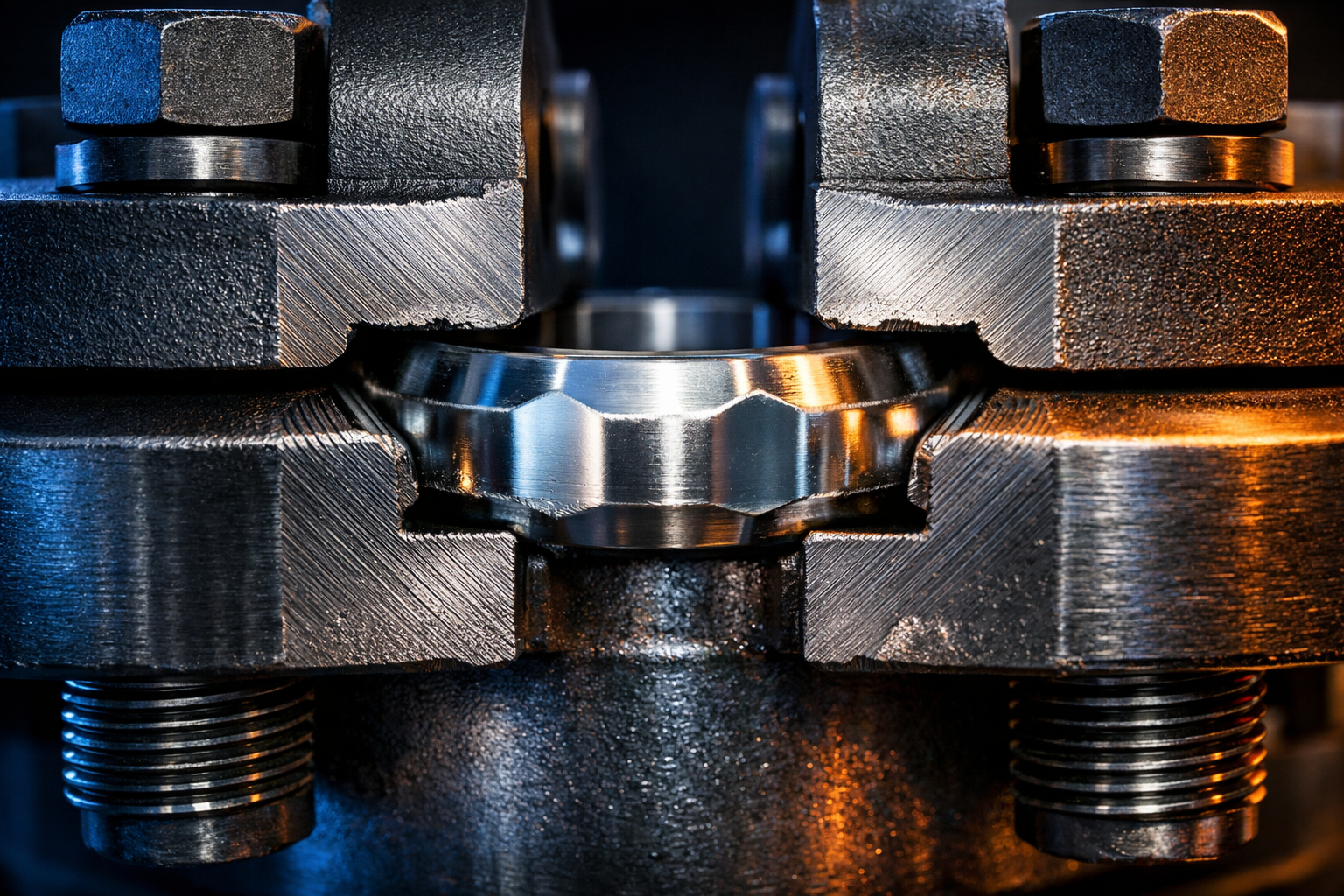
- The Groove: Instead of a flat or raised surface, an RTJ flange has a precision-machined groove cut into its face.
- The Ring: A soft, ductile metal ring (the “Ring Type Joint”) sits in this groove.
- The Seal: When the two flanges are bolted together, the ring is compressed and forced to flow into the microscopic imperfections of the groove walls. This creates a pressure-energized, metal-to-metal seal. As system pressure increases, it acts on the back of the ring, forcing it tighter into the groove and enhancing the seal.
Key Components and Specifications
Flange Grooves: Groove dimensions are standardized under API 6A for wellhead equipment and ASME B16.5/B16.47 for piping. Common styles include “R” (oval ring) and “R.X” (octagonal ring) grooves. The groove must be machined to exacting tolerances for the seal to function.
Ring Gaskets: The rings are the heart of the seal. They are typically made from soft iron, low-carbon steel, or various alloys (like 316 Stainless, Inconel) chosen for corrosion resistance and ductility.
- R-Rings: Oval in cross-section. Used in standard API and ASME applications.
- RX-Rings: Octagonal in cross-section and pressure-energized. They provide a higher sealability and can sometimes seal in R-grooves.
- BX-Rings: Octagonal and used exclusively with API 6BX flanges (for 5,000 PSI and above). They are smaller, harder, and designed for the most extreme pressures.
RTJ Flange Types: R, RX, and BX
Understanding the different ring and flange systems is critical for proper selection and safety.
| Ring Cross-Section | Oval | Octagonal | Octagonal (smaller, harder) |
| Primary Standard | ASME B16.5 / B16.20, API 6A | API 6A | API 6A |
| Pressure Class | Commonly 900, 1500, 2500 | High-Pressure Service | Very High-Pressure (5,000 PSI, 10,000 PSI, 15,000 PSI, 20,000 PSI) |
| Sealing Mechanism | Gasket compression | Pressure-energized | Pressure-energized, requires flange hub engagement |
| Key Application | High-pressure process piping, some wellhead | Enhanced sealing in API 6B flanges | Mandatory for API 6BX flanges (e.g., wellheads, Christmas trees) |
| Reusability | Limited | More reusable than R-rings | Not recommended; rings are often one-time use |
Advantages and Disadvantages of RTJ Flanges
Advantages:
- Extreme Pressure & Temperature Rating: The metal-to-metal seal handles conditions that would destroy non-metallic gaskets.
- Pressure-Energized Seal: The seal improves as internal system pressure increases.
- Robustness: Highly resistant to crushing, blow-out, and thermal cycling.
- Proven Reliability: The standard for critical, hazardous service where failure is not an option.
Disadvantages:
- High Cost: Precision machining of flanges and rings is expensive.
- Complex Installation: Requires careful alignment, specific bolt torque procedures, and often special ring installation tools.
- Weight & Bulk: RTJ flanges are thicker and heavier than equivalent RF flanges.
- Limited Reusability: Ring gaskets are often deformed during sealing and cannot be reliably reused.
Note: For high-quality industrial flanges used in piping and fabrication, visit Texas Flange, a trusted flange manufacturer specializing in precision-engineered flange solutions.
Common Applications and Industries
RTJ flanges are specified where safety and absolute containment are paramount.
- Oil & Gas Wellheads & Christmas Trees: This is the primary application for BX-style flanges. They contain raw reservoir pressures.
- High-Pressure Process Piping: In refineries and chemical plants for hydrogen, ammonia, and high-pressure steam service (often using R-style rings).
- Subsea Pipelines & Manifolds: Where remote operation and zero leakage are critical.
- Nuclear Power Plants: For certain high-integrity auxiliary systems.
How to Specify and Order RTJ Flanges
Specifying an RTJ flange requires more detail than a standard flange. You must define:
- Flange Specification: Standard (e.g., API 6A, ASME B16.5), Pressure Class (e.g., 1500, 2500, 10,000 PSI), and material.
- Ring Joint Type: Clearly state R, RX, or BX.
- Ring Number: The specific ring size (e.g., R37, BX-153).
- Ring Material: Must be compatible with the flange material and service fluid (e.g., Soft Iron, 316 SS, Inconel 625).
For context on standard flange sizing, refer to our guide on API 6A flange sizes and dimensions.
Frequently Asked Questions (FAQs)
1. Can I use an RTJ ring on a Raised Face flange?
No. The flange must have the corresponding machined groove (R, RX, or BX) to accept the specific ring type. The geometries are not interchangeable.
2. Are RTJ flanges leak-proof?
When properly selected, installed, and torqued, they provide a highly reliable, leak-tight seal suitable for the most severe services. No mechanical joint is 100% “proof,” but RTJ is the industry standard for maximum integrity.
3. Why are BX rings considered one-time use?
BX rings are designed to plastically deform into the groove to create the seal. Removing the flange typically distorts the ring, compromising its ability to re-seal perfectly. Reuse is strongly discouraged for safety.
4. What is the difference between API 6B and API 6BX flanges?
API 6B flanges are standard flanges (2,000 to 5,000 PSI) that can use R or RX rings. API 6BX flanges are for higher pressures (5,000 PSI and above) and require BX rings. They also have a mandatory hub-to-hub contact feature that prevents over-stressing the ring.
5. How do I torque bolts on an RTJ flange?
A cross-bolting pattern and controlled torque sequence are essential to compress the ring evenly without cocking the flanges. Follow ASME PCC-1 or the manufacturer’s guidelines. For critical service, bolt hydraulic tensioning is often used.
Conclusion
API Ring Type Joint flanges are engineered solutions for extreme pressure. Their metal-to-metal, pressure-energized sealing mechanism makes them indispensable for wellheads, high-pressure process lines, and any application where a standard gasket would fail.
The key to their successful use is understanding the specific system (R, RX, or BX), selecting compatible materials, and following rigorous installation procedures. While more complex and costly than standard flanges, their reliability in preventing catastrophic leaks justifies their use in critical service. Always consult relevant API/ASME standards and work with qualified engineers when specifying these components.